Defense Attorney
The Voice That Made It Work
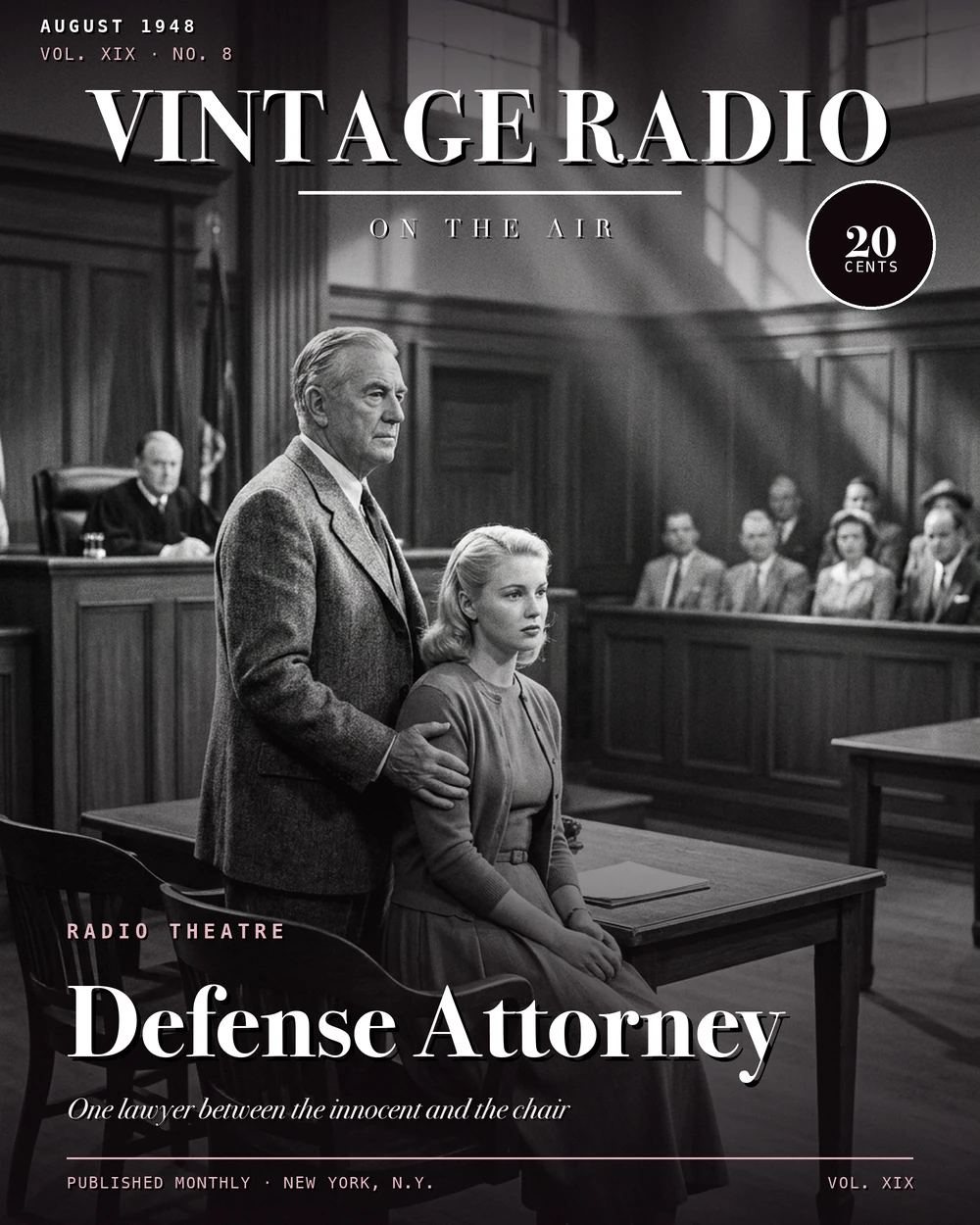
Orson Welles once called Mercedes McCambridge "the world's greatest living radio actress," and if you've heard her in almost anything, it's not a hard claim to sit with. She had a voice that was immediately recognizable — low, direct, with a quality that made you pay attention whether she was being gentle or aggressive. When ABC put her at the center of a legal drama in the fall of 1951, that voice was the engine the whole show ran on. Every episode opened with McCambridge speaking from an echo chamber, reciting a pledge on behalf of her character: "Ladies and gentlemen, to depend upon your judgment and to fulfill mine own obligation, I submit the facts . . . fully aware of my responsibility to my client and to you, as defense attorney." It was a simple device, but in McCambridge's delivery it became something worth tuning in for.
The character she played was Martha Ellis Bryant, a former district attorney who had crossed to the defense side of private practice. Martha was written as idealistic — someone who actually believed in the people she represented — and the show played that conviction straight rather than ironically. This was not a cynical procedural. Martha was someone trying to do right by her clients, and McCambridge made that legible in every scene without pushing it into sentiment.
Scholar Ron Lackmann, in his biography of McCambridge, noted that Bryant "spent more time solving crimes with her boyfriend ... than she did in the courtroom." That's a fair description of the format. Defense Attorney was less a courtroom drama than an investigation series with legal stakes. Martha went out into the field, got involved in the messy facts of cases, and then brought what she found back to bear on her clients' defense. The courtroom existed at the edges more than at the center.
How It Got on the Air
The road to ABC was not the road originally planned. The show started life as an audition recording titled "The Defense Rests" — made in April 1951, with the pilot episode presenting the case of Joseph Moriano. Creator Cameron Blake, identified by Radio Classics writer Elizabeth McLeod as a female writer, wrote that original script. The pitch was initially aimed at NBC as a summer replacement series. NBC liked it well enough but insisted the show be produced in New York.
Neither McCambridge nor her co-star Howard Culver wanted to relocate to New York for a temporary summer engagement, and the producers weren't inclined to push them. So the team reworked the package and brought it to ABC, which was willing to produce it in Hollywood. ABC aired the premiere on August 31, 1951. That logistical compromise — NBC's loss of a show because of a location requirement — turned out to be a reasonable trade for listeners, who got a full sixteen-month run from a cast that was settled and comfortable in their roles.
The series was produced by Don Sharpe, a Hollywood radio and television producer also associated with Terry and the Pirates and Sheena: Queen of the Jungle. Warren Lewis handled producing duties on the show directly, with Dwight Hauser directing. Joel Murcott was the primary writer across the run, with Bill Johnston contributing episodes as well. Rex Koury and Basil Adlam shared music duties. Orville Anderson announced. The show was pre-recorded rather than broadcast live, which gave the cast scheduling flexibility — a detail that mattered during production because McCambridge was pregnant in the summer and fall of 1951. That pregnancy ended in a stillbirth, a personal tragedy that added considerable strain to her marriage with director Fletcher Markle, whom she had married in 1950.
The Cast Around McCambridge
Howard Culver played Judson "Jud" Barnes, reporter for the City Dispatch and Martha Bryant's friend and fellow investigator. The two functioned as a team — she brought the legal angle, he brought the journalistic access — and Culver's easy manner made Jud a steady presence in the stories. Culver had come to Defense Attorney with a solid radio résumé: he had starred as Straight Arrow on Mutual from 1948 to 1951 and had been the last actor to play Ellery Queen on radio before signing on here. After the show ended, McCambridge used her industry contacts to arrange introductions for Culver at major studios, helping him get his first television credit. He eventually found a long-running TV role as hotel clerk Howie Uzzell on Gunsmoke.
The supporting cast was deep. Tony Barrett appeared most frequently as Detective Lieutenant Ed Ledis, the police contact who connected Martha and Jud to official investigations — though Barrett played multiple characters across the run, and his character's name appears in sources with varying spellings (Ledis, Leebis, Ledes). The bench beyond Barrett included Paul Frees, Dallas McKennon, Parley Baer, Lawrence Dobkin, Jeanne Bates, and Howard McNear, among others — a roster of working radio actors who turn up across dozens of shows from this period. Irene Tedrow and Harry Bartell also appeared. The show had the feel of a company working together, not a star surrounded by supporting players.
One moment captures the atmosphere of the production well. In one episode, Marty Bryant asks Jud Barnes who's singing on the jukebox. He tells her it's Mercedes McCambridge. She replies: "I didn't know she sang!" It's the kind of in-joke that only works when a cast is at ease with itself and its audience.
What the Stories Were About
The cases Martha took on reflected the anxieties of the early 1950s in a way that now reads as a fairly direct document of the period. Storylines touched on teenagers in hot rods, Communist threat themes, and racial tensions — the kinds of subjects that were generating real public concern in 1952 and that gave the show a grounding in contemporary life. The writers weren't using these as pure window dressing; they were the substance of the cases Martha was trying to resolve.
Elizabeth McLeod, writing in Radio Classics, characterized Defense Attorney as "one of the better programs of the 1951-52 season, network radio's last real stand before the explosion of television in 1953." That framing captures something real about where the show sat in the timeline. It was a well-made program arriving at the end of radio drama's commercial run, doing what that format did well — placing a strong actor in a recurring role and trusting the listener to follow.
The show's sponsors across its run included Clorets in 1951–52, followed by Kix Cereal and Goodyear in 1952. It aired Fridays at 8 through September 1951, then moved to Thursdays at 8 through October 1952, and finished its run on Tuesdays, eventually shifting to 8:30. The final broadcast was December 30, 1952.
The Recognition That Followed
The legal profession took Martha Bryant seriously enough to respond to the actress behind her. The Los Angeles Women's Bar Association gave McCambridge honorary membership based on her work on the show. The National Association of Women Lawyers honored her as well. In 1952, the American Bar Association invited her to address their annual meeting — a remarkable response to a fictional character, and an indicator of how the portrayal registered with working lawyers. Radio-TV Mirror magazine gave McCambridge its Favorite Dramatic Actress Award for the role.
A television version nearly happened. Fletcher Markle wrote and directed a pilot filmed by Desilu Productions. In March 1953, Billboard reported that Don Sharpe had traveled to New York to pitch the filmed version with McCambridge attached. The TV version was never sold.
Mercedes McCambridge Beyond the Show
McCambridge was born Carlotta Mercedes Agnes McCambridge on March 16, 1916, in Joliet, Illinois. She attended Mundelein College near Chicago on a drama scholarship, and on graduation in 1937, NBC Chicago program director Sidney Strotz recruited her directly for the NBC Merchandise Mart acting company. Her radio credits before Defense Attorney ran wide: she was an original cast member of The Guiding Light, appeared on I Love a Mystery (where she was a favorite of writer-producer Carlton E. Morse), Abie's Irish Rose, Inner Sanctum, Lights Out, Suspense, The Shadow, and Orson Welles' Mercury Theater broadcasts. Welles was directly acquainted with what she could do, which gives his praise a different weight than an honorary quote.
She had already won an Academy Award for Best Supporting Actress before Defense Attorney — her debut film role, as Sadie Burke in All the King's Men (1949), earned her the Oscar, making her one of very few actors to win for a first film performance. She received a second nomination for Giant (1956), directed by George Stevens, losing to Dorothy Malone. In 1973, she provided the voice of the demon Pazuzu in The Exorcist — initially uncredited, with the Screen Actors Guild having to intervene to restore her credit in a new print of the film. She has two stars on the Hollywood Walk of Fame, one for motion pictures at 1722 Vine Street and one for television at 6243 Hollywood Boulevard. She published her autobiography, The Quality of Mercy, in 1981 through New York Times Books. In 1974, Dick Van Dyke credited her with having "broke the ice for the rest of us" by speaking publicly about her alcoholism. She achieved sobriety through Alcoholics Anonymous in 1969 and became a prominent advocate for treatment programs afterward. She died March 2, 2004, in La Jolla, California, at age 87.
Defense Attorney was a relatively brief run — sixteen months on ABC — but it produced a character substantial enough to earn the attention of actual legal organizations and to leave a mark on the career of one of radio drama's most distinctive performers.